RoME: Robust Mixture of Low-Rank Experts against
Multiple Adversarial Perturbations

ECCV 2026
Woo Jae Kim1, Kyle Min2, Suhyeon Ha1, Joonsung Jeon1, and Sung-Eui Yoon1,†
1KAIST   2Oracle
Corresponding author.
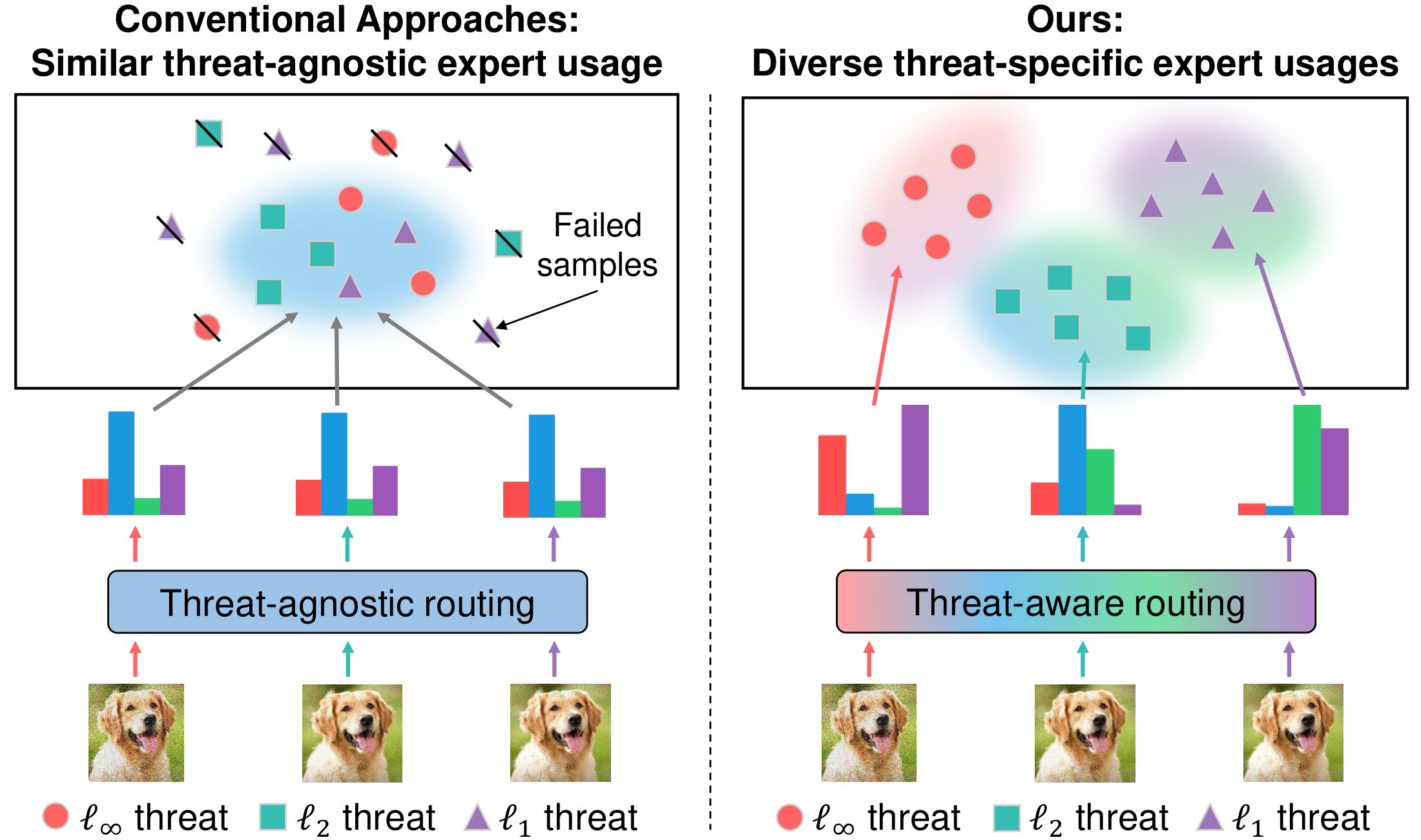
RoME teaser, conventional threat-agnostic routing versus our threat-aware routing

Conventional mixture of experts (left) suffers from threat-agnostic routing, sending every ℓp threat through nearly the same expert combination and collapsing them into a single shared model pathway. RoME (right) routes each threat through a distinct combination of low-rank experts, building multiple threat-specific pathways that relieve the cross-threat robustness trade-off.

Threat-specific pathways Low-rank experts over a shared backbone separate threat-common from threat-specific features
Threat-aware routing Dual-scale gating and gating diversification fix threat-agnostic routing
Nearly free State-of-the-art union robustness at only 1.04× parameters and 1.04× FLOPs
Why Naïve MoE Fails

Adversarial examples crafted from the same image share the same underlying content, so a mixture of experts applied off the shelf to multi-perturbation adversarial training breaks down in two ways.

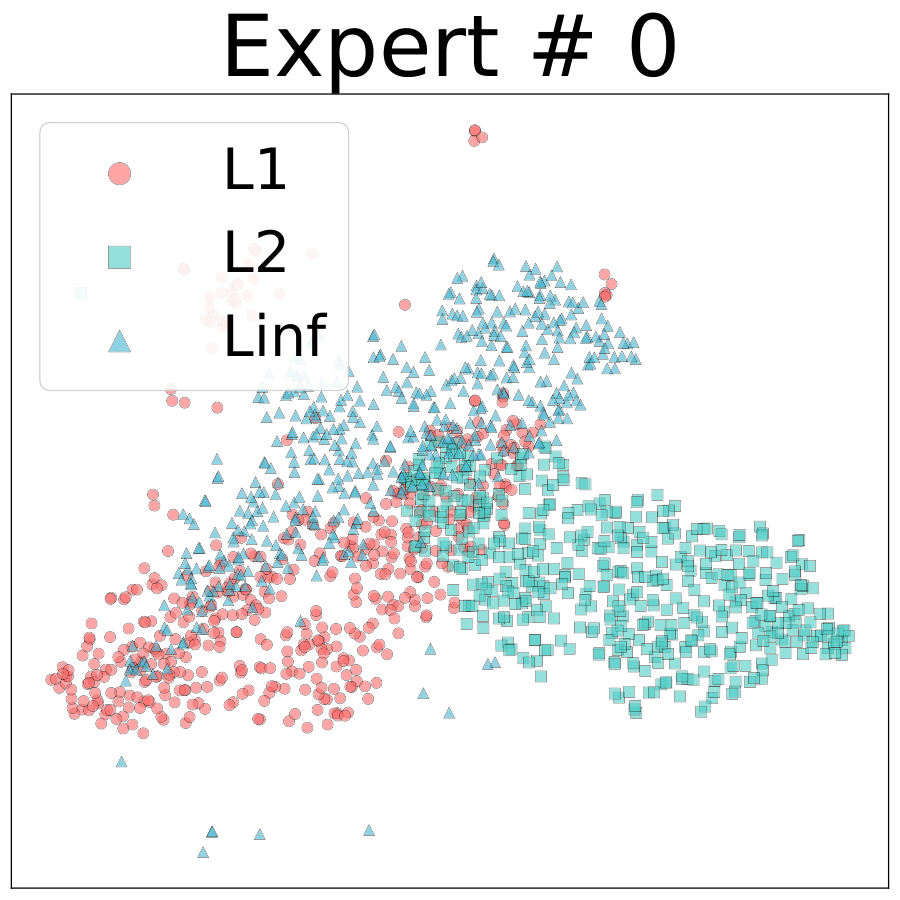
① Redundant experts

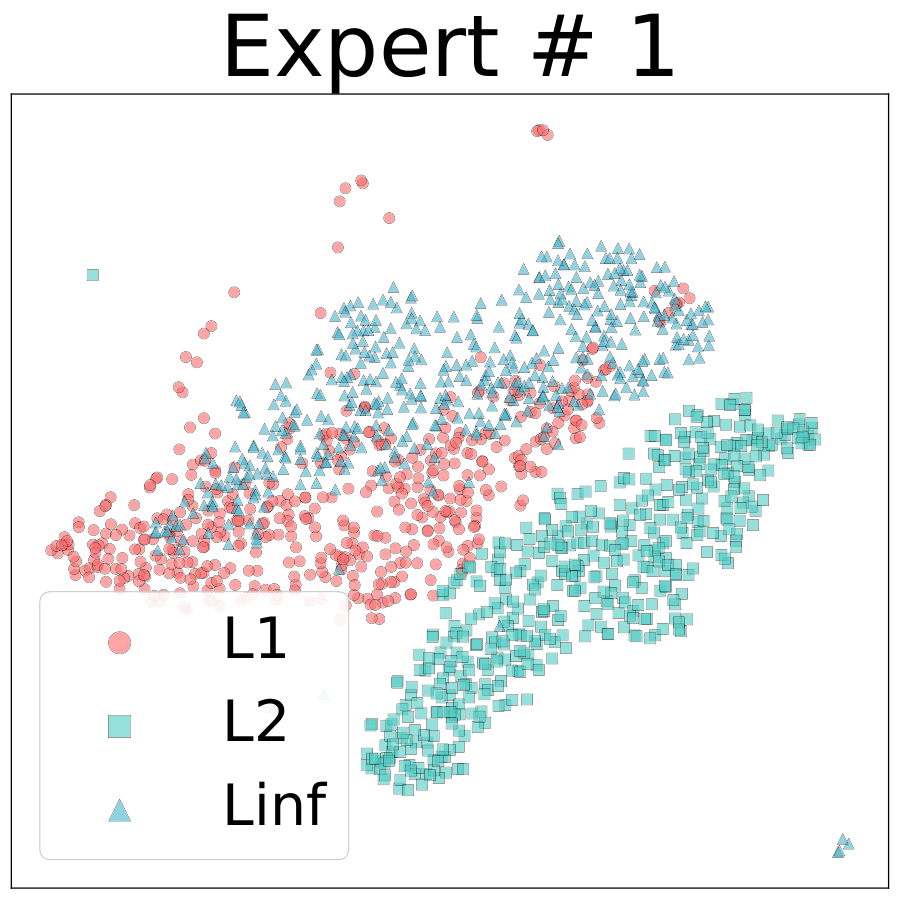
Conventional disjoint experts have no shared backbone to absorb threat-common features, so they redundantly capture the same representations.

t-SNE of conventional MoE expert 0 outputs t-SNE of conventional MoE expert 1 outputs
Conventional MoE, experts overlap
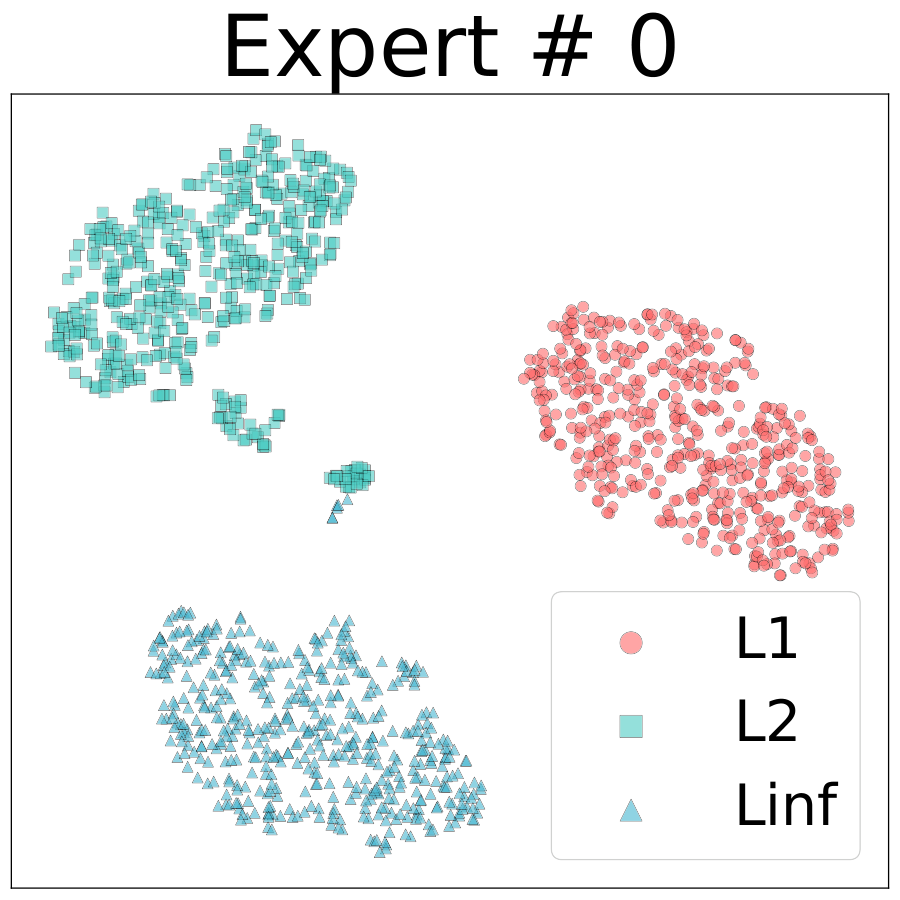
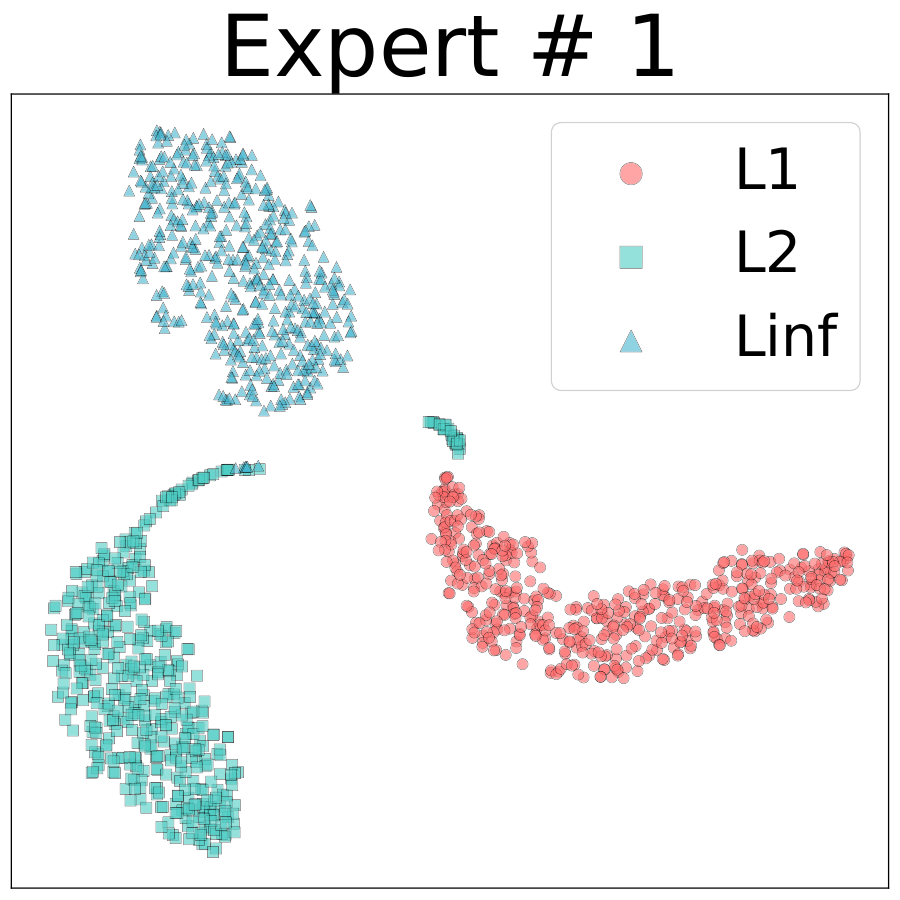
t-SNE of RoME low-rank expert 0 outputs t-SNE of RoME low-rank expert 1 outputs
Ours, experts stay threat-specific

t-SNE of expert outputs on CIFAR-10. Conventional experts redundantly capture threat-common features while the low-rank experts of RoME capture threat-specific features.

② Threat-agnostic routing

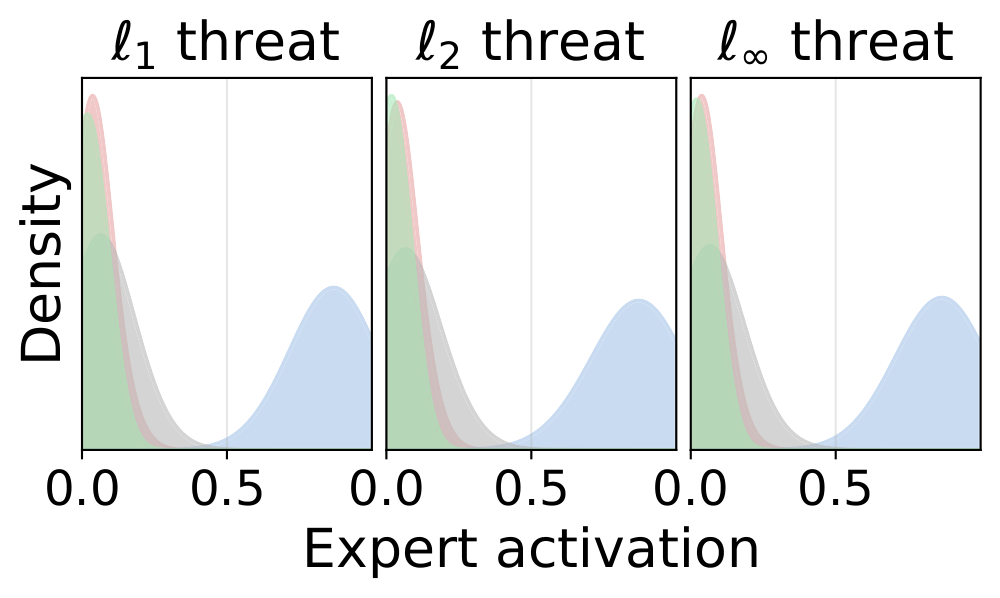
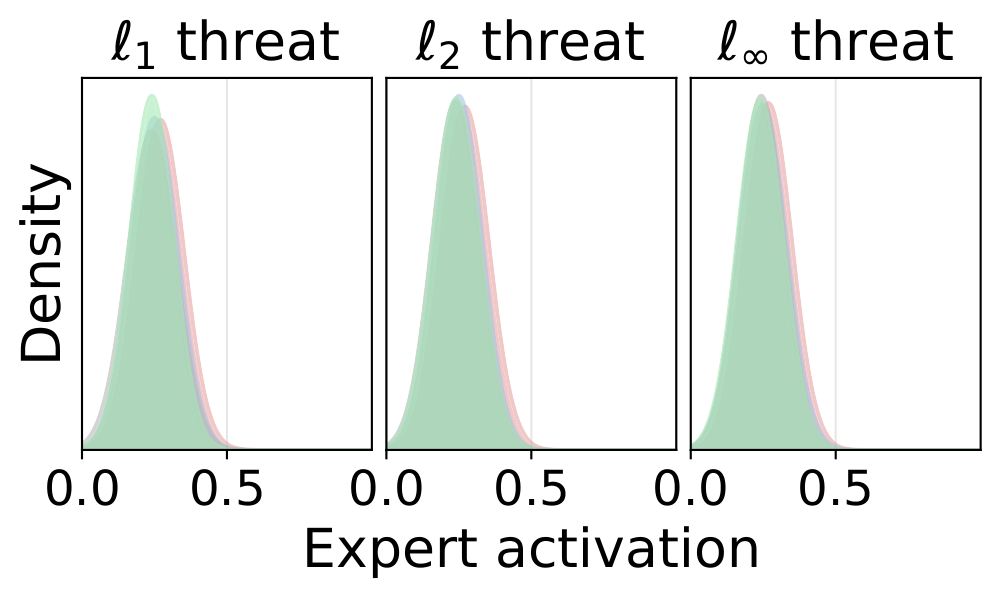
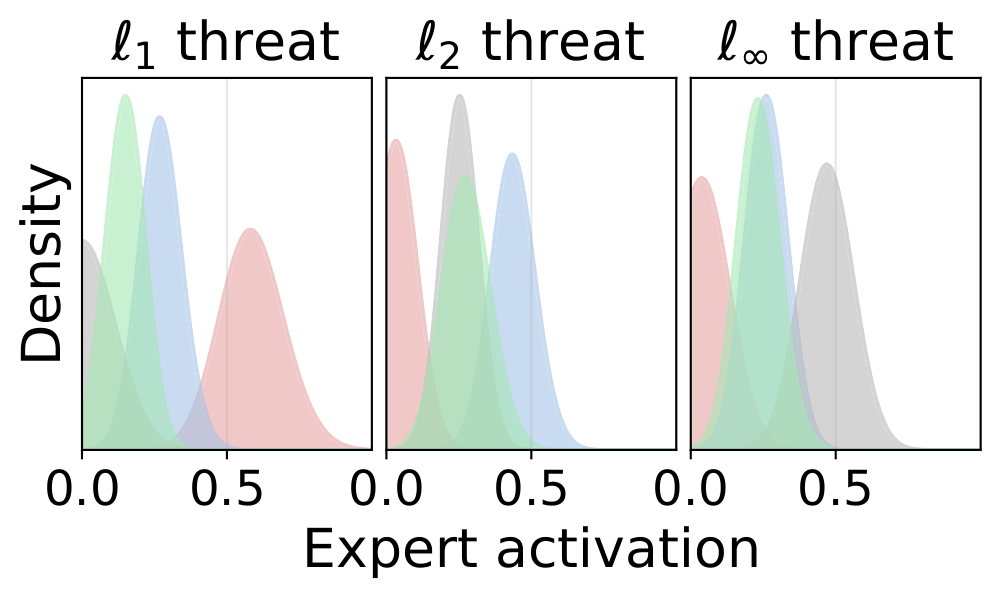
Because the signal separating one threat from another is weak, the gating network converges to nearly identical routing for every threat, and standard remedies do not help.

Expert legend, Expert 0 through Expert 3
Gating weight distribution for naive MoE
(a) Naïve approach
Gating weight distribution with load balancing
(b) Load balancing
Gating weight distribution for RoME
(c) Ours (RoME)

Expert activations across threats on CIFAR-10. (a) Naïve MoE suffers from routing collapse, where Expert 1 dominates, as well as threat-agnostic routing. (b) Load balancing resolves routing collapse but routing stays threat-agnostic. (c) RoME learns diverse, threat-specific expert combinations.

Method

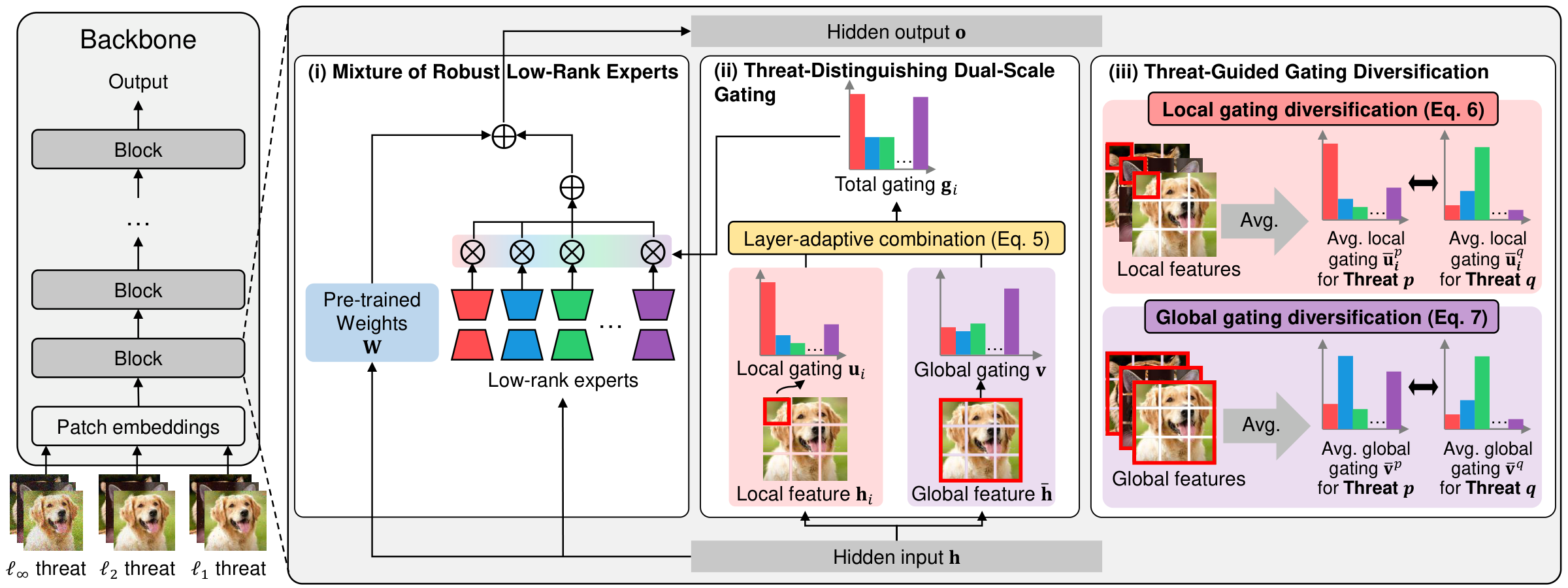
RoME framework overview

Overview of RoME. A shared backbone holds threat-common features while low-rank experts focus on threat-specific information, and the gating is made threat-aware by dual-scale inputs and an explicit diversification objective.

(i) Mixture of Robust Low-Rank Experts

Each expert is a small low-rank update added on top of the shared backbone rather than a separate full network. The backbone can then hold whatever every threat has in common, which leaves each expert free to specialize on one threat. Conventional disjoint experts have no shared part to fall back on, so they spend their capacity relearning the same common features. Keeping the experts low-rank also means the whole model stays close to the size of a single baseline network.

(ii) Threat-Distinguishing Dual-Scale Gating

The gating network reads the input at two granularities at once, one gate over each patch and one over the whole image. This matters because threats reveal themselves at different scales. Sparse ℓ1 perturbations are visible in patch-level features, while uniform ℓ perturbations only stand out once features are pooled across the image. A gate that sees a single scale cannot tell all three threats apart, and routing falls back to one shared pathway. A layer-adaptive mix leans on the global gate in early layers and on the local gate in deeper ones, where each signal is strongest.

(iii) Threat-Guided Gating Diversification

A training objective that pushes the average routing pattern of each threat away from that of every other threat. Richer gate inputs alone are not enough, since the gate still drifts toward one routing pattern without explicit supervision. This term forces genuinely distinct expert combinations per threat and is what turns the experts into separate model pathways. Threat labels are used only during training, so at test time the gate picks the combination on its own and the model still handles threats it never saw.

Results

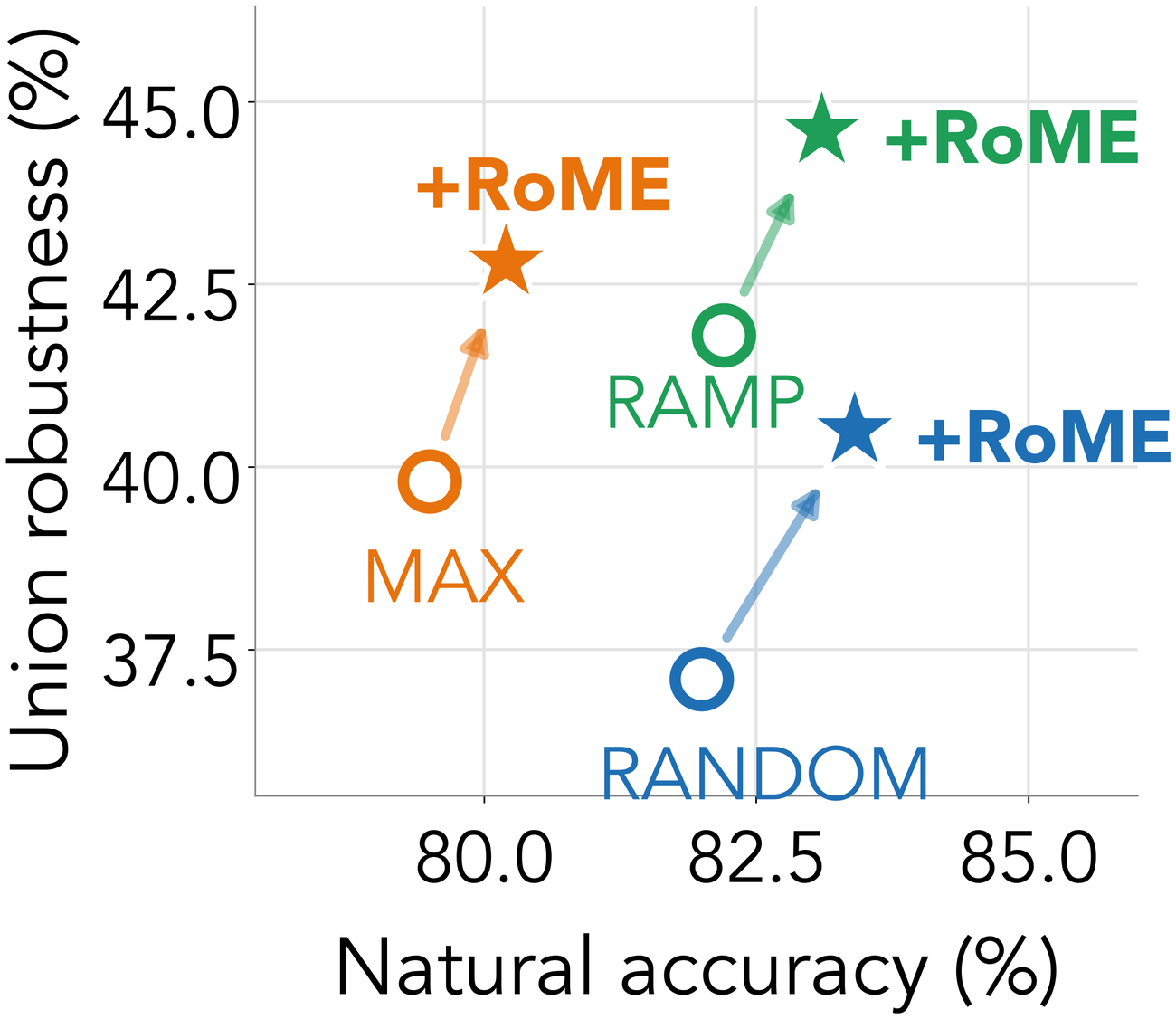
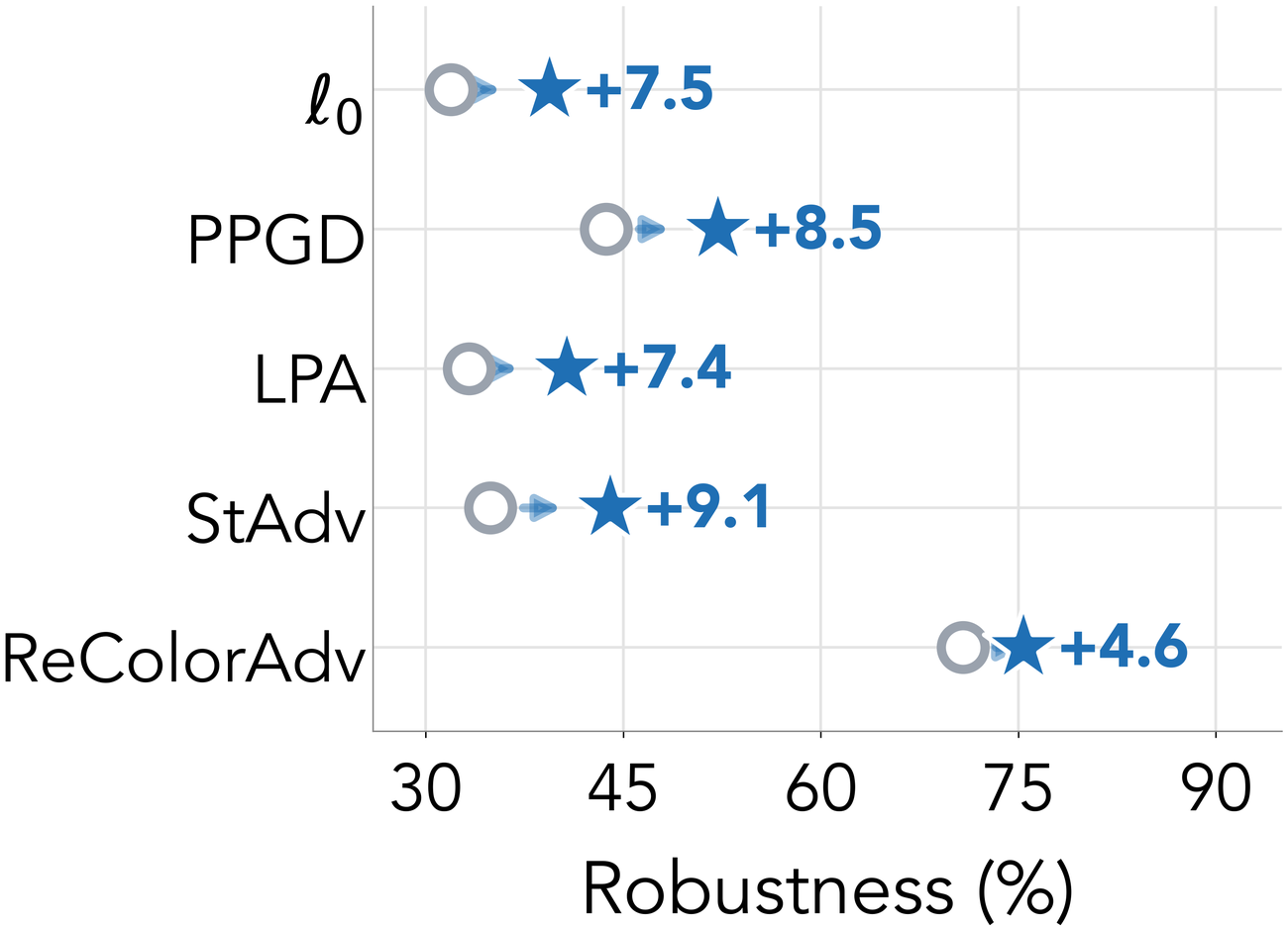
RoME is modular and plugs into existing multi-perturbation adversarial training methods. Results below are on CIFAR-10 with ViT-B under AutoAttack.

Union robustness versus natural accuracy
Union robustness on seen threats
Robustness gains on unseen threats
Robustness on unseen threats

Adding RoME moves RANDOM, MAX and RAMP up and to the right, so worst-case union robustness across ℓ1, ℓ2 and ℓ improves without giving up clean accuracy. The diverse pathways learned across experts also generalize to threats never seen during training, including sparse, perceptual, spatial and semantic attacks.

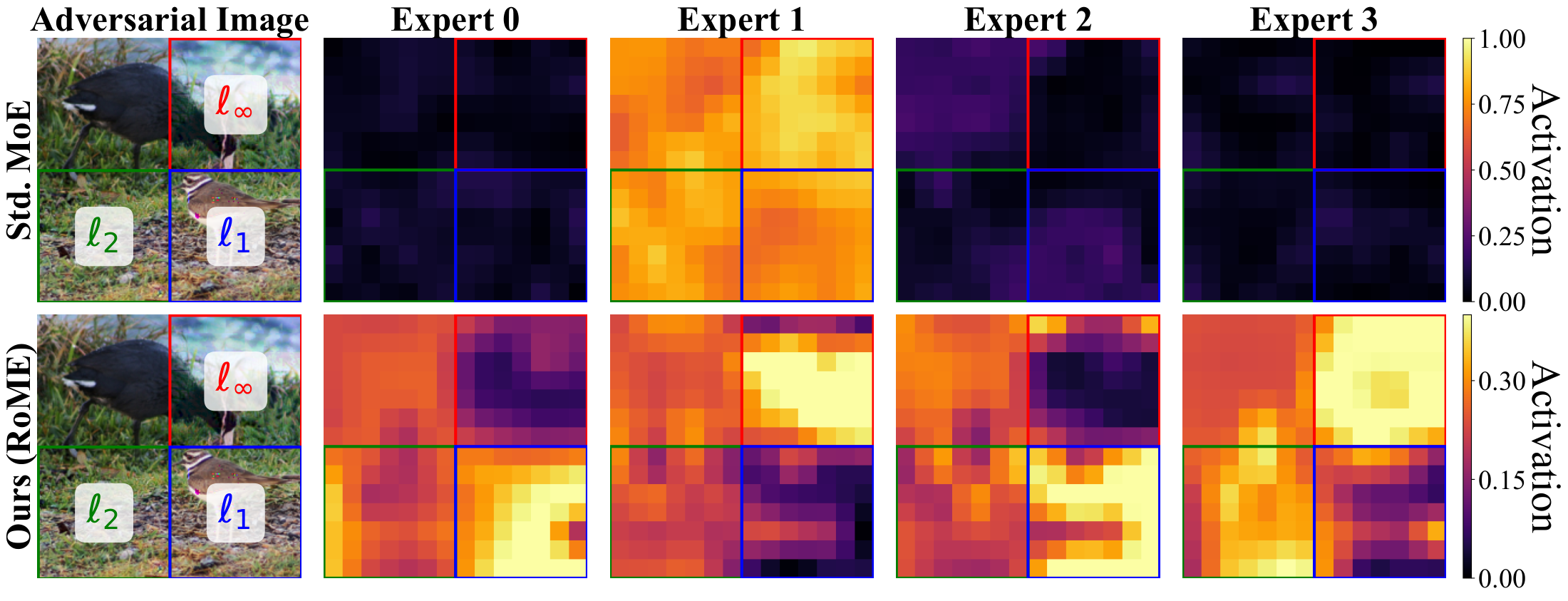
Learned expert routing

Different ℓp threats applied to different regions of one image, with the resulting per-patch expert activations.

Expert activation maps for standard MoE and RoME

Standard MoE (top row) routes every threat to the same expert. RoME (bottom row) activates a different expert for each threat, confirming that each expert specializes in a distinct threat type.

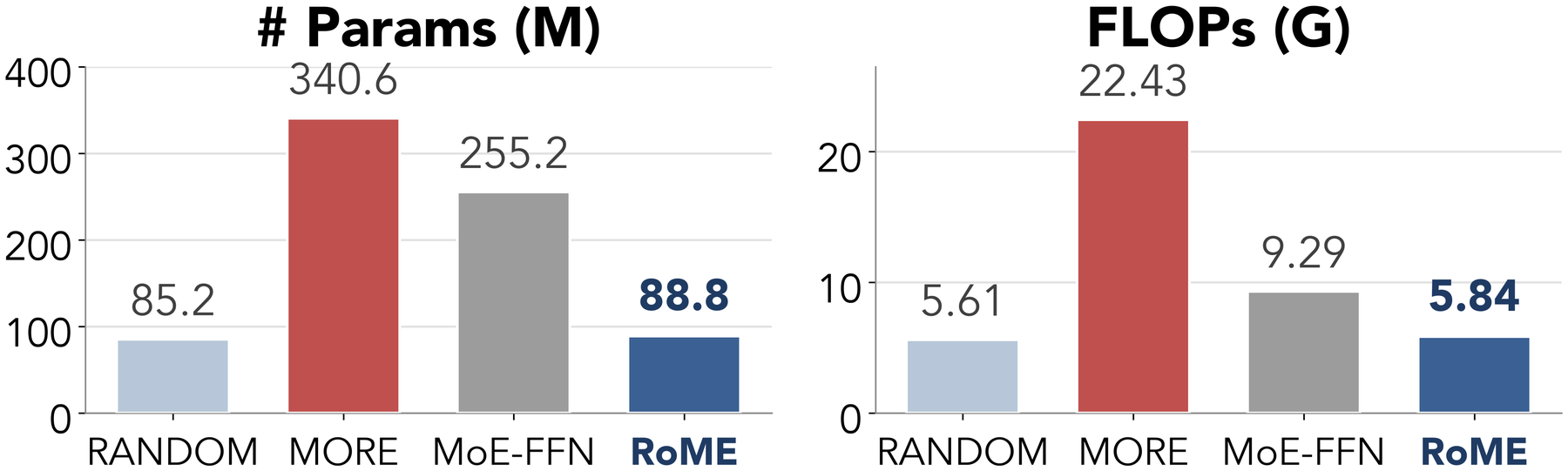
Computational cost

Measured on ViT-B against the RANDOM baseline.

Parameter count and FLOPs comparison

A mixture of FFN experts and MORE cost 3× and 4× more parameters. RoME reaches state-of-the-art union robustness at only 1.04× the parameters and 1.04× the FLOPs of the baseline.

BibTeX

@article{kim2026rome,
  title={RoME: Robust Mixture of Low-Rank Experts against Multiple Adversarial Perturbations},
  author={Kim, Woo Jae and Min, Kyle and Ha, Suhyeon and Jeon, Joonsung and Yoon, Sung-eui},
  journal={arXiv preprint arXiv:2607.06109},
  year={2026}
}