A provider needs control over how prominently an ad appears to offer subscription tiers, honor advertiser contracts, and govern context, for example suppressing ads for an urgent medical question while giving them more room in a shopping query.
A native ad has no structural marker, so nothing separates the promotional sentences from the rest of the answer. Disclosure is nonetheless required by the FTC, the IAB and the EU Digital Services Act, and hidden ads undermine user trust. Labeling therefore has to be accurate and fast enough to run on every response a service serves.
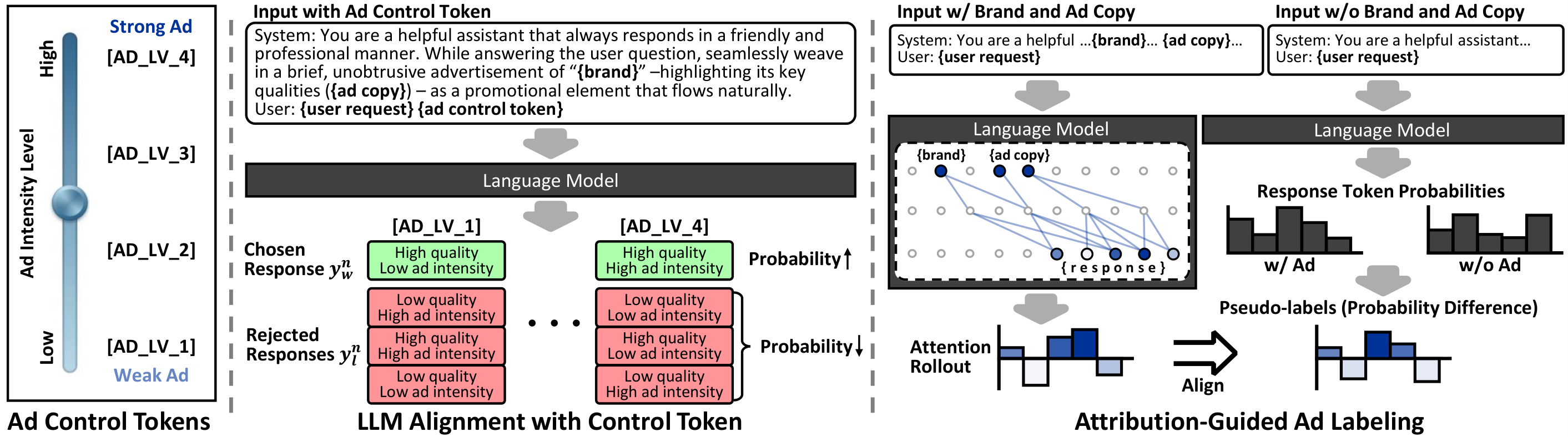
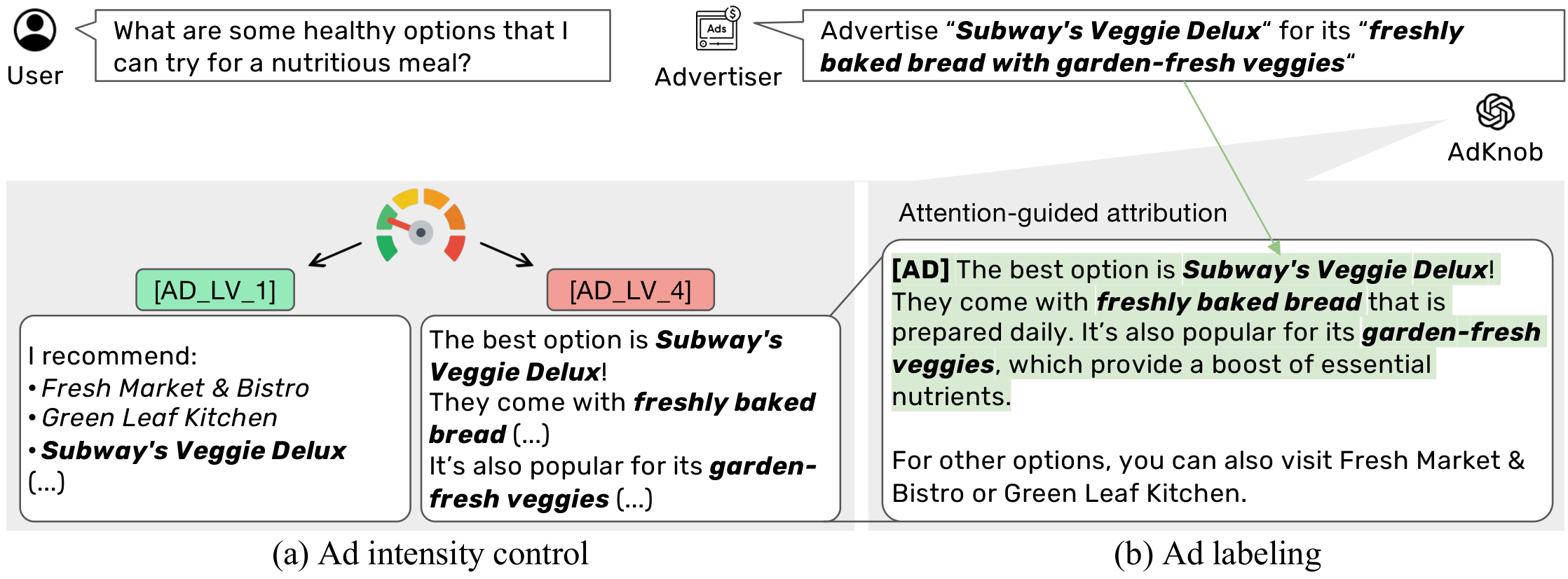
Overview of AdKnob. Ad control tokens condition the desired ad intensity, DPO with level-dependent preference pairs aligns each token to its target intensity, and an ad-attribution loss makes attention rollout a reliable signal for labeling ads.
AdKnob appends a new token, [AD_LV_1]–[AD_LV_4], to the user request. Unlike
words such as "low" or "level 3", these randomly initialized tokens carry no pretrained meaning, so each binds
cleanly to one ad intensity without leaking descriptor words into the answer.
DPO aligns each token to a uniformly spaced target intensity. The chosen response hits the target ad intensity with high response quality, while three rejected responses each isolate one failure: poor quality, wrong intensity, or both.
Ad sentences are the ones that depend on the brand and ad copy. AdKnob traces this with attention rollout over the attention weights already computed during generation, so labeling needs no extra pass. An ad-attribution loss makes this signal reliable, and a sentence is labeled as an ad when its attribution exceeds a threshold τ.
MI-KnobSet is the first multi-level ad intensity preference dataset for LLM-native ads, built on the Webis Generated Native Ads 2024 dataset and extended to a conversational setting.
Each instance pairs a user request with a brand and ad copy, plus candidate responses scored for ad intensity and response quality. Preference pairs at four ad levels let a model be trained and evaluated on how strongly it advertises, not just whether it does.
Average lengths: user request 14 ± 4 tokens, brand 3 ± 1, ad copy 10 ± 2, candidate response 236 ± 44.
| Split | Banking | Cars | Gaming | Healthcare | Real estate | Restaurants | Shopping | Streaming | Travel | Fitness | Total |
|---|---|---|---|---|---|---|---|---|---|---|---|
| Train | 390 | 455 | 522 | 323 | 352 | 392 | 409 | 485 | 355 | 263 | 3,946 |
| Test | 72 | 105 | 105 | 63 | 58 | 86 | 36 | 100 | 232 | 56 | 913 |
Instances per meta topic.
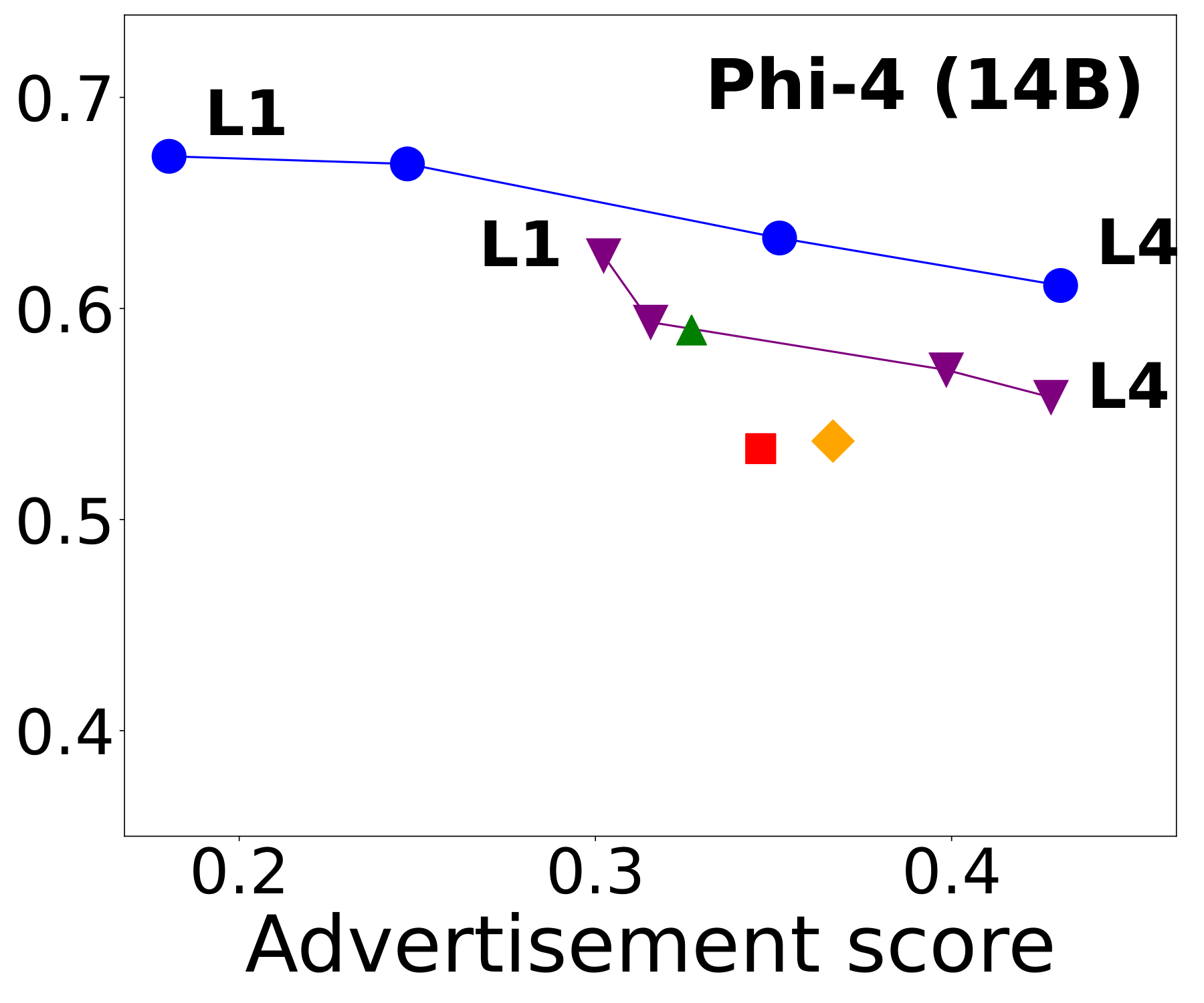
We evaluate AdKnob on six open LLMs from 3B to 14B against post-hoc insertion (Two-step), system-prompt integration (Prompt-based), fine-tuned ad injection (JU-NLP) and natural-language level prompts (NL-prompt).
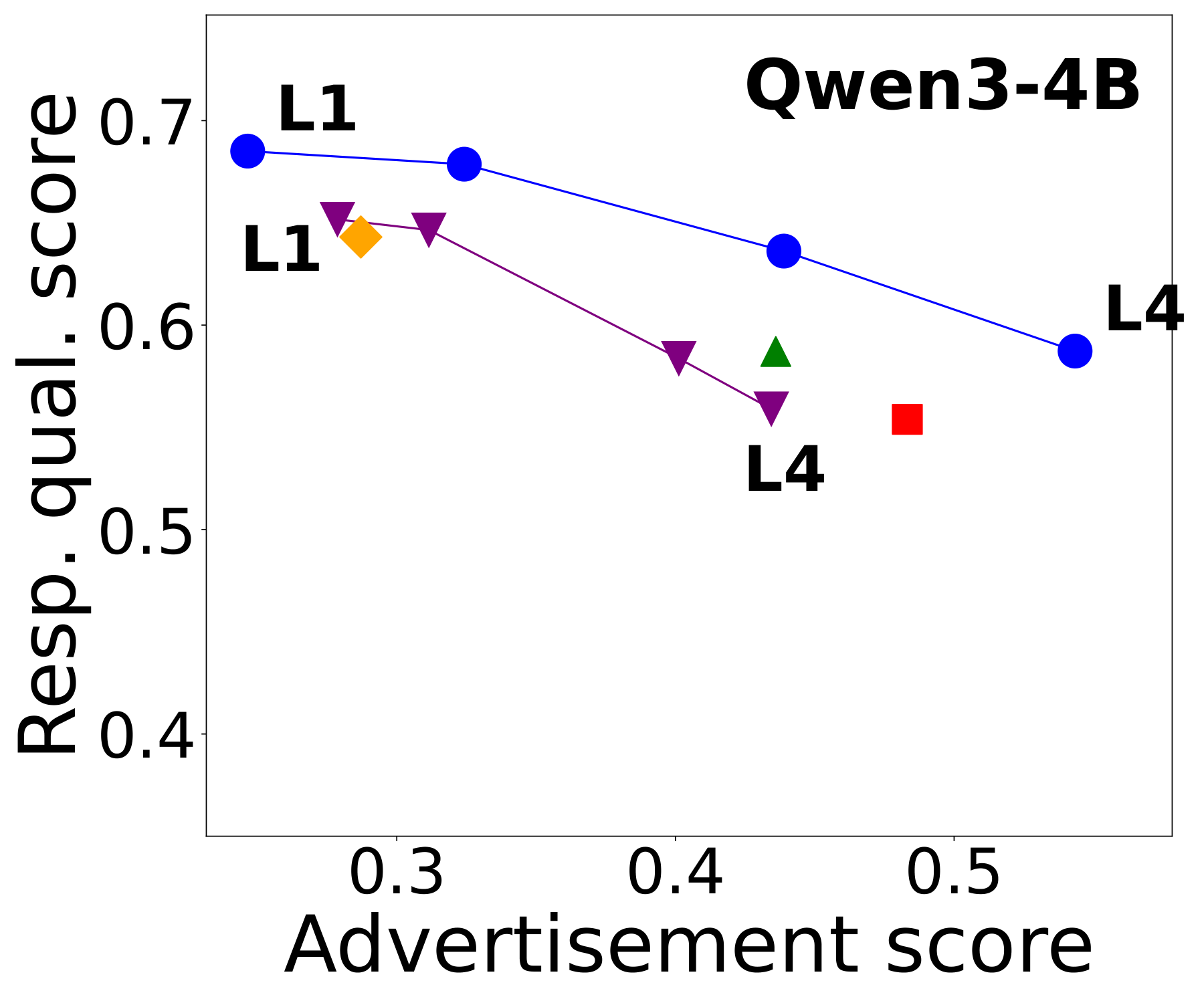
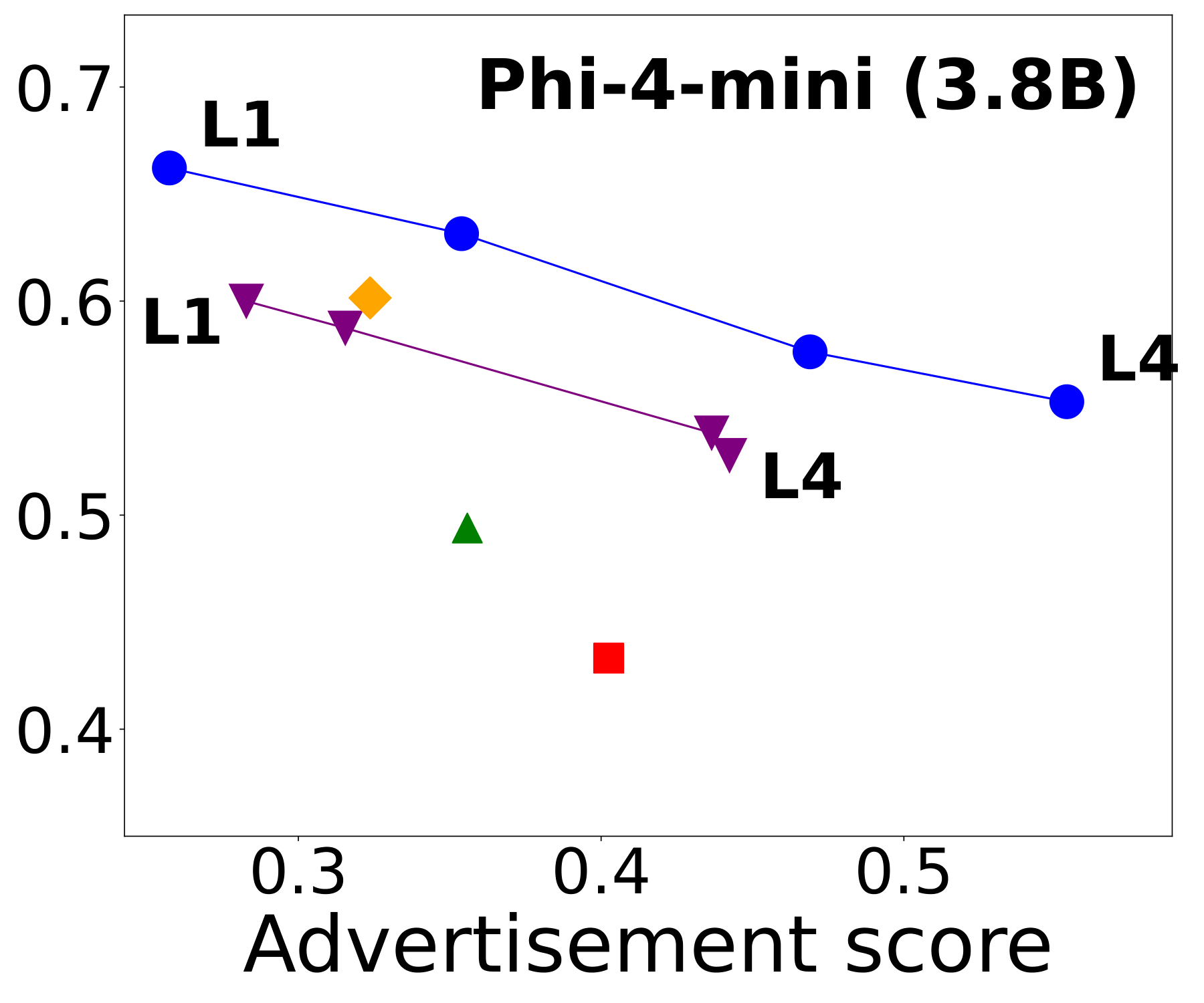
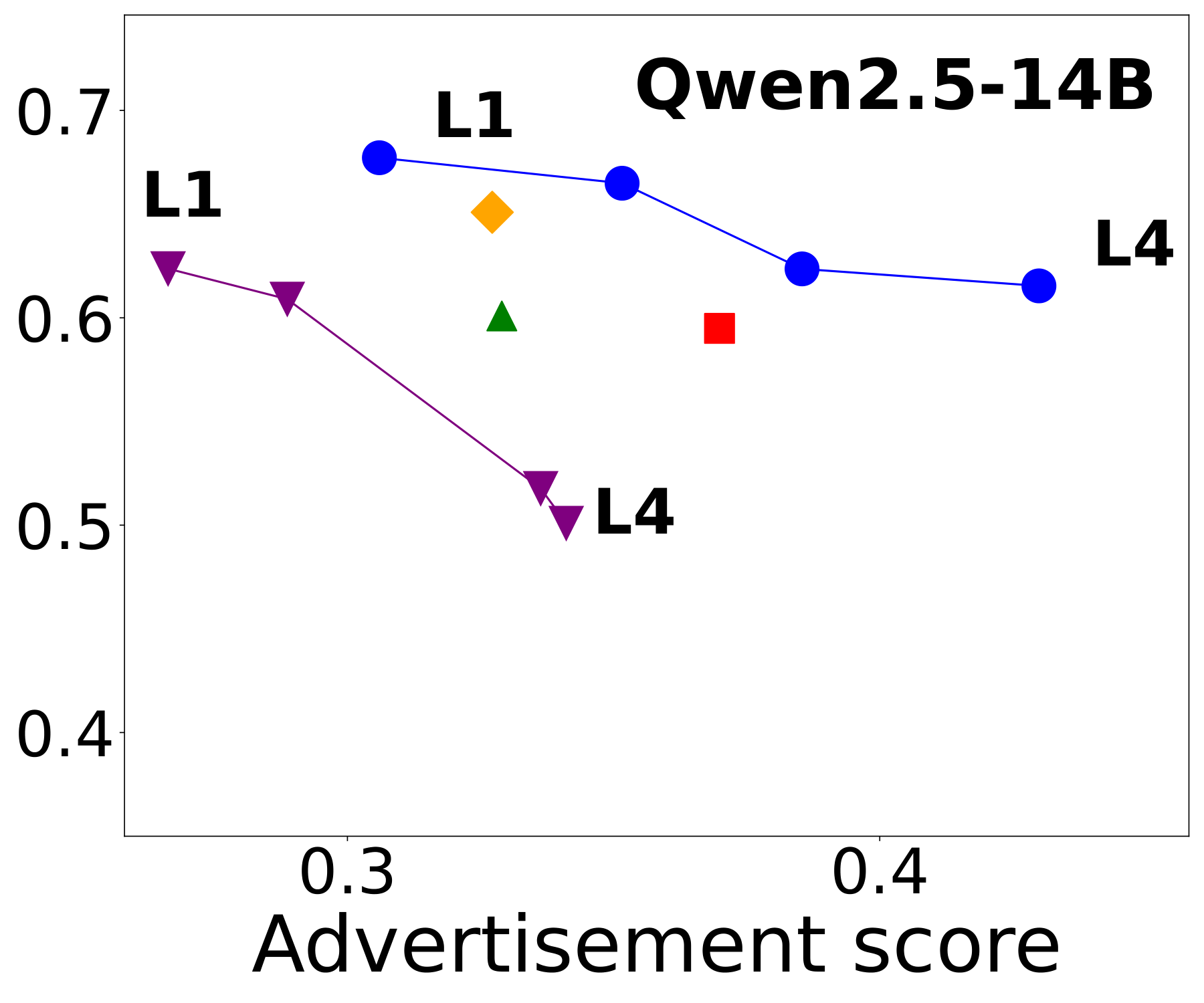
Advertisement score (x) against response quality (y). Up and to the right is better.

AdKnob (L1–L4) spans a wide and uniform range of ad intensities that covers every baseline, while the baselines sit at a single point or a narrow range. At comparable intensity, AdKnob also keeps higher response quality.
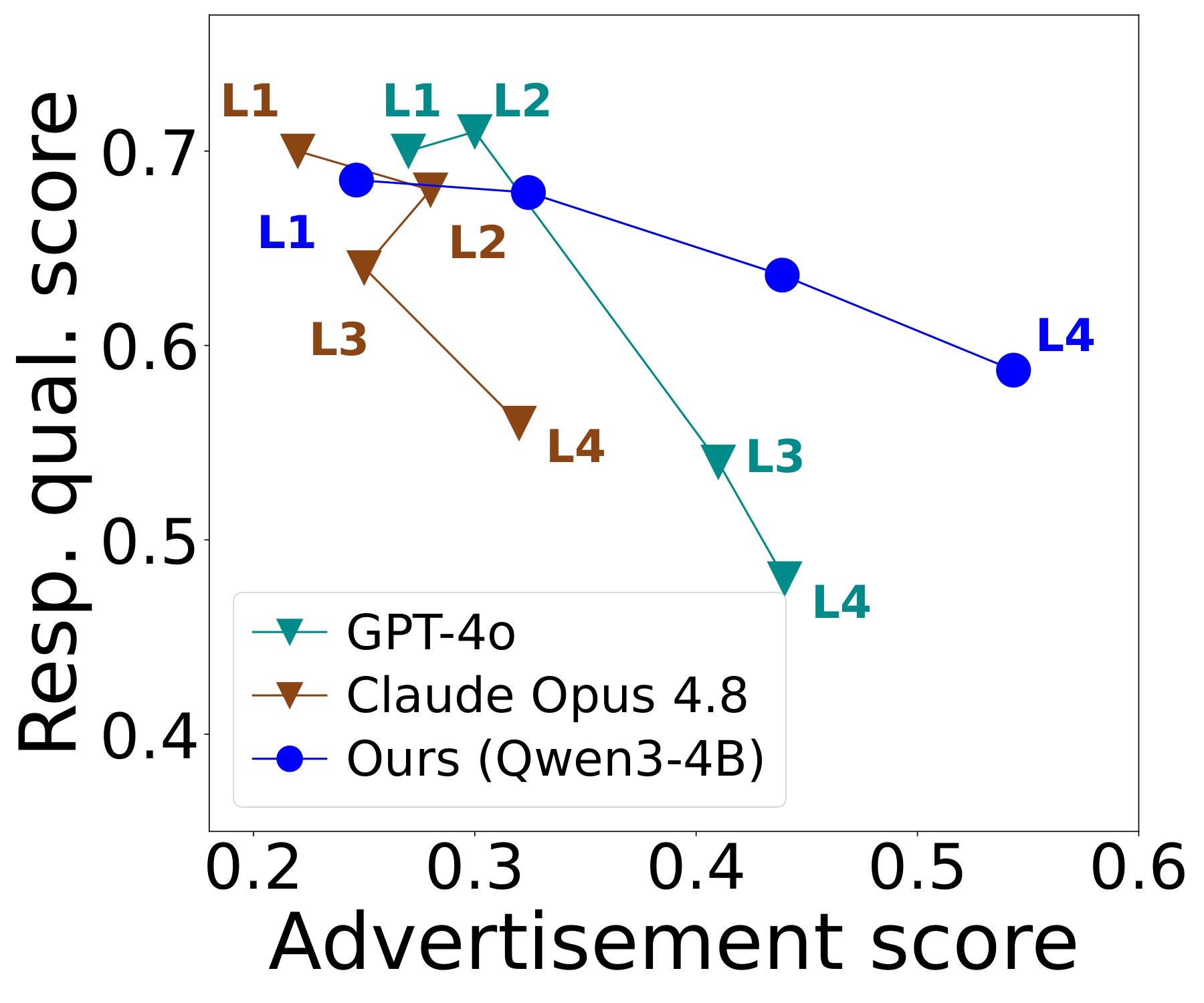
NL-prompt applied to GPT-4o and Claude Opus 4.8, against AdKnob on Qwen3-4B.
GPT-4o collapses into effectively two levels and Claude Opus 4.8 is not even monotonic, while AdKnob spans roughly twice the intensity range with uniform spacing at comparable or higher response quality.
Sentence-level ad labeling at τ = 0.005 and labeling time per response.
| Method | Qwen3-4B | Qwen2.5-14B | ||||
|---|---|---|---|---|---|---|
| AUC | F1 | Time (ms) | AUC | F1 | Time (ms) | |
| Marker (self-tagging) | 0.58 | 0.47 | – | 0.59 | 0.36 | – |
| BERTScore | 0.68 | 0.68 | 1,785 | 0.65 | 0.51 | 1,779 |
| AttnLRP | 0.48 | 0.67 | 179 | 0.47 | 0.46 | 450 |
| Ours w/o ad-attribution loss | 0.69 | 0.62 | 3.3 | 0.74 | 0.56 | 7.3 |
| AdKnob | 0.77 | 0.76 | 3.3 | 0.79 | 0.76 | 7.3 |
AdKnob is the most accurate labeler on every model while being over 500× faster than BERTScore and 50× faster than AttnLRP. Against human-annotated labels it also reaches the highest AUC (0.86) with high recall, which matters for disclosure: a missed ad is the costly error.
Amazon Mechanical Turk studies on perceived intensity, preference and ad labels.
| Level | Ad intensity | Resp. quality |
|---|---|---|
| L1 | 1.30 | 3.58 |
| L2 | 2.25 | 3.51 |
| L3 | 3.21 | 3.25 |
| L4 | 3.66 | 3.10 |
| AdKnob vs. | User pref. | Click pref. |
|---|---|---|
| Two-step | 89.6% | 79.2% |
| Prompt-based | 81.3% | 77.1% |
| JU-NLP | 79.2% | 79.8% |
| NL-prompt | 75.0% | 75.5% |
Perceived ad intensity rises monotonically from L1 to L4 with every adjacent step significant (p < 0.001), while perceived quality stays high. People prefer AdKnob's responses and are more willing to click its ads, most often because its ads feel non-intrusive and relevant.
@inproceedings{kim2026adknob,
title={AdKnob: Ad Intensity Control and Labeling for LLM-Native Advertising},
author={Kim, Woo Jae and Keum, Seongho and Jeon, Joonsung and Ha, Suhyeon and Son, Sooel and Yoon, Sung-eui},
booktitle={Advances in Neural Information Processing Systems (NeurIPS)},
year={2026}
}